Find Differences: An Educational Game for Cognitive Development
Find Differences is a simple yet powerful educational game that sharpens observational skills and promotes critical thinking. While it’s often associated with children's learning, its benefits extend to learners of all ages. This game challenges players to identify subtle distinctions between two seemingly identical images. Whether used in classrooms, at home, or in digital formats, Find Differences supports cognitive growth, attention to detail, and visual discrimination.
How Find Differences Enhances Learning
The core idea behind Find Differences is straightforward: spot what’s different between two similar images. But beneath this simple premise lies a wealth of developmental benefits. The game encourages players to focus, analyze, and compare details — skills that are crucial in both academic and real-life settings.
For children, especially preschoolers, Find Differences helps build early literacy and visual perception. It also supports fine motor skills when used in worksheet formats where kids circle or mark the differences. In digital formats, it can improve hand-eye coordination and familiarity with interactive tools.
Why People Choose Find Differences
Many educators and parents turn to Find Differences because it’s adaptable and engaging. It doesn’t require advanced reading skills, making it ideal for young learners. It also offers a low-pressure way to introduce problem-solving and persistence — players must keep searching until they find all the differences.
- Boosts attention span through focused observation
- Encourages patience and persistence as players search for hidden details
- Supports logical reasoning by promoting pattern recognition
Using Find Differences in Different Settings
This game is versatile and can be integrated into various environments:
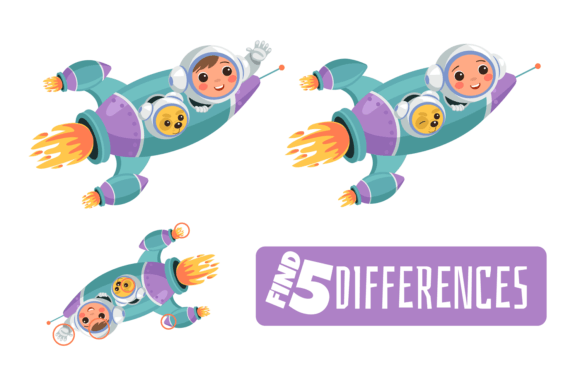
- Classroom learning: Teachers use Find Differences to reinforce themes like space, animals, or seasons. For example, a “Boy flying on a space rocket” worksheet can make learning about astronomy more interactive.
- Home education: Parents can print worksheets or use apps to provide fun learning breaks during homeschooling sessions.
- Digital platforms: Game developers and marketers incorporate Find Differences into websites and apps to improve user engagement and retention.
Professionals in graphic design or illustration may also use variations of this concept to test visual acuity or create educational content. Vector formats like EPS and JPG are commonly used to produce high-quality, scalable images for these purposes.
Real-World Examples and Applications
Consider a preschool worksheet where a cartoon boy is flying on a rocket. Two versions of the image are nearly identical, but one has a missing star, a differently colored helmet, or a swapped background cloud. Children must locate all the differences — a fun way to blend storytelling with learning.
Another example is a logic task where adults must find the correct answer among multiple visual clues. These types of puzzles appear in magazines, brain-training apps, and even job aptitude tests. They serve as a quick mind test that evaluates attention to detail and analytical thinking.
What to Consider Before Using Find Differences
While Find Differences is widely beneficial, choosing the right version matters. Here are a few things to keep in mind:
- Age-appropriateness: Younger children need clear, obvious differences, while older users may enjoy more complex puzzles.
- Visual clarity: Ensure images are high quality and differences are fair — not too obscure or frustrating.
- Learning goals: Align the game with educational objectives, such as vocabulary building or visual memory.
If you're creating or purchasing Find Differences content, consider using vector-based formats like EPS or JPG for scalability and adaptability across different platforms.
Why Find Differences Stands Out Among Educational Games
Unlike many educational tools that require specific subject knowledge, Find Differences is accessible to everyone. It’s a universal brain exercise that doesn’t rely on language or math skills. This makes it ideal for diverse classrooms or multilingual families.
Additionally, it can be customized for different themes — space, animals, holidays, or daily life — making it both flexible and fun. A “Funny astronaut” theme, for instance, can capture children’s imagination while they learn without realizing it.
Conclusion: A Simple Game With Lasting Benefits
Find Differences is more than just a game — it’s a tool for learning and development. Whether you're a parent looking for engaging activities, a teacher planning a lesson, or a content creator designing educational materials, this game offers value across many contexts.
Its blend of entertainment and education makes it a favorite among children and adults alike. By integrating Find Differences into daily routines or creative projects, you support essential cognitive skills in a way that feels rewarding and fun.